The Impact of Serverless Architecture on Microsite Development
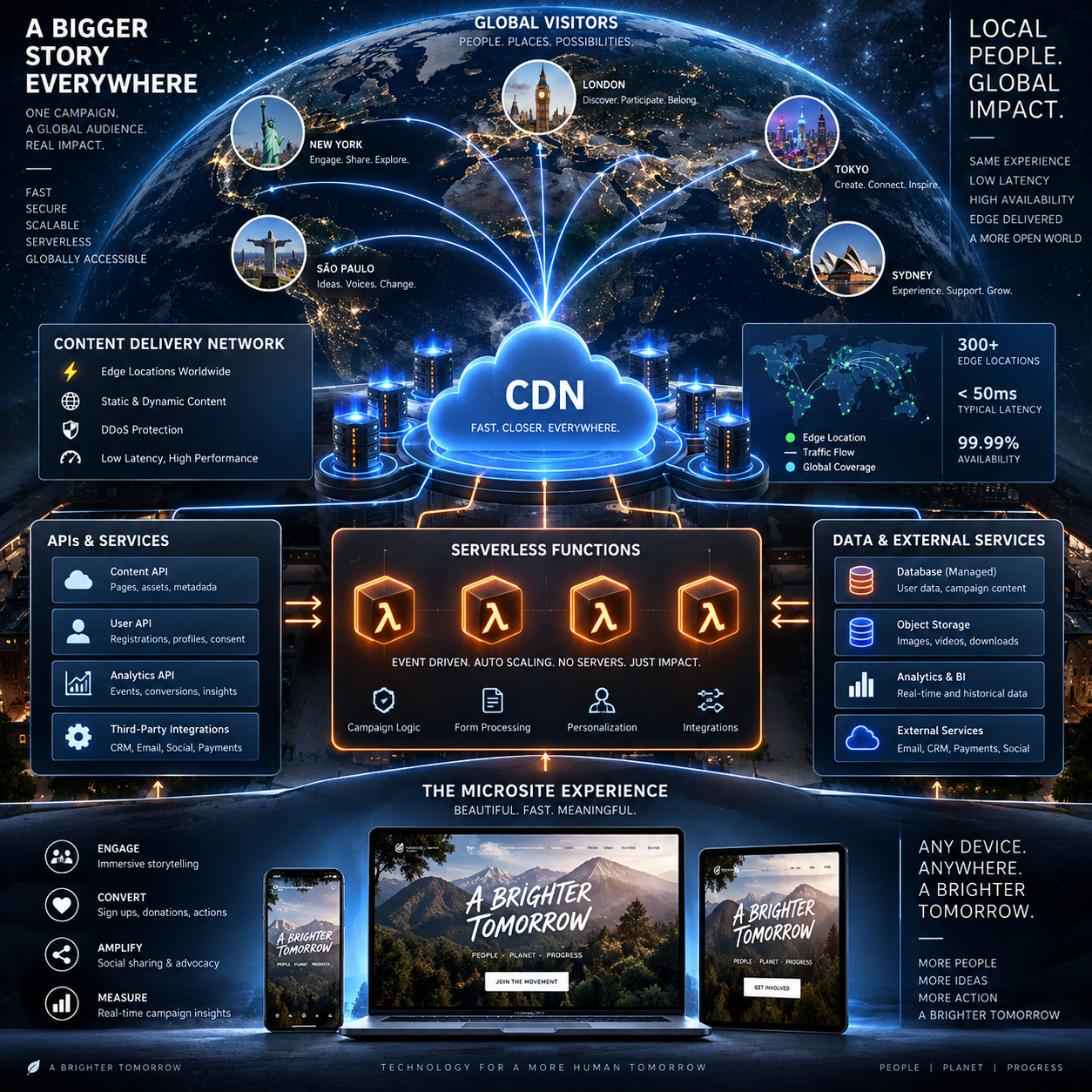
Serverless architecture is changing how teams plan, build, launch, and retire microsites. Instead of maintaining a dedicated server, developers combine static site generation, a content delivery network (CDN), Function as a Service (FaaS), and managed services to deliver focused digital experiences.
That model suits many campaign pages, product launches, event sites, and interactive landing pages. It is not automatically the best choice, though. The right decision depends on traffic patterns, functionality, integrations, content workflows, security responsibilities, and how long the microsite must remain online.
What Is Serverless Architecture?
Serverless architecture runs application code through managed cloud services rather than requiring a team to provision and maintain traditional servers. Developers still use infrastructure, but the cloud provider manages much of the operating system, capacity planning, patching, and request routing.
A typical serverless microsite has a statically generated frontend hosted on object storage or a specialized hosting platform. A CDN serves HTML, JavaScript, CSS, images, and other assets from locations close to visitors. When someone submits a form or requests personalized data, an event can trigger a short-lived function.
These functions are commonly described as Function as a Service (FaaS). They execute in response to events such as HTTP requests, form submissions, scheduled tasks, or file uploads. The function completes its task and stops, so the team does not manage a continuously running application server.
Traditional hosting usually allocates a virtual machine, shared server, or container that remains available around the clock. That approach can provide predictable control and straightforward debugging, while serverless shifts more operational responsibility to the provider and introduces platform-specific limits.
Why Serverless Is Relevant to Microsite Development
Serverless is relevant to microsite development because microsites often need fast launches, focused functionality, and the ability to absorb unpredictable campaign traffic without permanent infrastructure. A small site may be quiet for weeks and then receive a major surge after an announcement or advertisement.
Many microsites are mostly static. A generator can create pages during deployment, after which the CDN delivers them efficiently. This is a strong fit for brand campaigns, conference information, recruitment drives, product announcements, and seasonal promotions.
Serverless becomes more useful when the site needs lightweight dynamic behavior, including:
- Lead forms that send data to a CRM or email platform.
- API integrations for product availability, event schedules, maps, or registrations.
- Personalized content based on a visitor’s selection or campaign source.
- Small calculators, quizzes, eligibility checks, or gated downloads.
- Webhooks that connect the microsite to analytics, marketing automation, or payment services.
This creates a practical split: static site generation handles presentation, while serverless functions handle narrow backend tasks. The result can be simpler than building a full application, provided the project avoids unnecessary service complexity.
Key Benefits for Microsite Hosting
Serverless microsite hosting can improve scalability, deployment speed, operational efficiency, and global delivery, especially when static assets do most of the work. These benefits come from matching infrastructure behavior to the short-lived and variable nature of many microsites.
Scalability without manual capacity planning
Serverless platforms can create additional function instances as demand rises, subject to provider quotas and account limits. A CDN can absorb much of the traffic for cached assets, reducing the number of requests that reach dynamic services.
That elasticity is valuable for a campaign with uncertain reach. It does not mean unlimited capacity. Teams should review concurrency limits, regional availability, database throughput, API quotas, and provider throttling before launch.
Faster launches and less infrastructure management
Developers can deploy a frontend and a small set of functions without configuring a web server, operating system, or load balancer. Deployment automation can connect a source-control branch to preview environments and production releases, shortening the path from approved content to a live microsite.
Choosing this convenience means accepting more dependence on provider tooling. A simple static host may be easier than a multi-service cloud setup when the microsite has no dynamic requirements.
Performance and flexible operating costs
CDN delivery, compressed assets, image optimization, and prebuilt HTML can produce fast page loads. Static content also reduces the work required for each visitor compared with server-rendering every request.
Costs may be attractive for low or irregular usage because teams often pay according to storage, requests, bandwidth, and function execution. However, large media files, heavy traffic, frequent API calls, or inefficient functions can change the calculation. Compare a realistic traffic model with the fixed price of traditional microsite hosting rather than assuming serverless is cheaper.
Challenges and Limitations to Consider
Serverless architecture has limitations, including cold starts, provider dependency, execution limits, pricing uncertainty, and more distributed debugging. These issues rarely disqualify a microsite, but they should influence architecture and testing decisions.
Cold starts and execution limits
A function that has not run recently may need time to initialize its runtime. This cold start can add latency to the first request, particularly with large dependencies or certain runtimes. For a contact form, that delay may be acceptable. For an interactive tool requiring instant responses, it may need mitigation through smaller packages, warm instances, caching, or a different hosting model.
Functions also have maximum execution times, memory allocations, payload sizes, and concurrency settings. Long-running jobs, intensive media processing, and persistent connections may fit better on containers or conventional application hosting.
Debugging and service sprawl
A request can pass through a CDN, frontend host, function, identity service, database, and third-party API. A failure may therefore involve permissions, environment variables, timeouts, rate limits, or an external provider. Centralized logs, request identifiers, structured error messages, and synthetic monitoring become essential.
Lock-in and pricing variability
Provider-specific event systems, databases, authentication tools, and deployment frameworks can make migration difficult. Teams should document interfaces, keep business logic modular, and understand export options before committing to a platform.
Pricing also requires care. Estimate normal traffic, campaign peaks, cache-hit ratios, function calls, data transfer, storage, logs, and third-party API usage. A low-traffic site may cost very little, while an unexpectedly popular or poorly cached campaign can generate a different bill.
How Serverless Changes the Microsite Development Process
Serverless changes microsite development by encouraging a decoupled frontend, narrowly defined backend functions, automated deployment, and earlier attention to observability. The development process should begin with request flows, not with a list of cloud products.
- Classify each feature. Mark it as static content, browser-side interaction, serverless function work, or third-party API activity.
- Define the data path. For every form or integration, specify validation, authentication, storage, retries, failure messages, and retention.
- Generate and optimize the frontend. Use static site generation where possible, compress images, remove unused JavaScript, and set cache policies deliberately.
- Automate deployment. Use version control, review branches, preview deployments, environment-specific secrets, and a repeatable production release.
- Test realistic failures. Simulate API timeouts, duplicate submissions, expired credentials, invalid input, function limits, and traffic bursts.
- Plan retirement. Archive content, remove unused functions and credentials, redirect valuable URLs, and confirm that third-party connections are closed.
Content teams also need a clear update model. A fully static microsite may require a rebuild when content changes, while a headless CMS can trigger a rebuild automatically. That adds flexibility, but also introduces webhook security, preview management, and another service to monitor.
Security, Performance, and Reliability Best Practices
Secure and reliable serverless microsites use least-privilege access, protected APIs, deliberate caching, optimized assets, monitoring, and tested fallback behavior. The cloud provider secures its platform, but the project team remains responsible for application code, configuration, data, and access control.
- Apply least privilege: give each function only the permissions it needs, separate deployment credentials from runtime credentials, and rotate secrets.
- Protect forms and APIs: validate input on the server side, use HTTPS, apply rate limits, filter spam, verify webhook signatures, and avoid exposing private keys in frontend code.
- Design the cache deliberately: cache versioned static assets for longer periods, use suitable cache-control headers, and avoid caching personalized or sensitive responses.
- Optimize the delivery path: use responsive images, modern formats, code splitting, prebuilt pages, and a CDN with suitable geographic coverage.
- Monitor the whole chain: track function errors, latency, cold starts, CDN status, API failures, form completion, and unusual traffic or cost patterns.
- Prepare fallbacks: provide a useful static error page, queue or safely retry noncritical requests, and decide what visitors see if an external API is unavailable.
Run load tests within the provider’s terms and compare results against expected launch traffic. Reliability is a system property: a fast CDN cannot compensate for a fragile registration API, and a healthy function cannot fix oversized frontend assets.
When Should You Choose Serverless for a Microsite?
Choose serverless for a microsite when the project benefits from CDN-delivered static content, variable traffic, short development cycles, and small event-driven backend tasks. Choose traditional hosting or a hybrid approach when persistent processes, predictable workloads, or operational simplicity matter more.
Use this decision filter:
- Mostly static content: serverless hosting with static site generation and a CDN is usually a strong fit.
- Occasional forms or API calls: add focused functions rather than deploying a full backend.
- Sudden, uncertain traffic: investigate function concurrency, CDN caching, provider quotas, and external API capacity before launch.
- Long-running or stateful workloads: consider containers, a managed application server, or a hybrid architecture.
- Strict portability requirements: favor standard web technologies and limit dependence on proprietary services.
- Small operations team: serverless can reduce server administration, but only if monitoring, billing controls, and deployment workflows remain understandable.
A useful rule is to separate the site into three layers: content, interaction, and operations. If content is static, interaction is lightweight, and the team can monitor managed services, serverless is often compelling. If any layer requires persistent processes or deep platform control, compare a hybrid design before deciding.
Frequently Asked Questions
Is serverless architecture suitable for every microsite?
No. It works well for static campaigns and lightweight interactions, but persistent connections, long-running jobs, specialized runtimes, or strict portability requirements may favor traditional hosting or containers.
How does serverless hosting affect microsite performance?
Static site generation and CDN delivery can reduce delivery latency, while cold starts may slow the first dynamic function request. Asset size, cache configuration, code quality, and third-party APIs often matter more than the hosting label.
Can a serverless microsite handle sudden traffic spikes?
Often, yes, because functions can scale with demand and CDNs can serve cached assets. Confirm quotas, concurrency, origin limits, database capacity, and third-party API rate limits before a campaign launch.
What are the main security concerns with serverless microsites?
Common concerns include over-permissioned functions, exposed secrets, weak input validation, unsecured APIs, insufficient rate limiting, vulnerable dependencies, and poor monitoring of third-party integrations.
Is serverless cheaper than traditional microsite hosting?
It can be economical for low or variable usage, but it is not automatically cheaper. Compare storage, bandwidth, function calls, logs, data transfer, API services, support, and engineering time with the fixed cost of conventional hosting.