How CDNs Optimize Microsite Performance for Global Audiences
A microsite built for a product launch or seasonal campaign lives and dies by its first impression. Visitors arrive from paid ads, social shares, or QR codes — and they expect instant load times regardless of where they are in the world. A Content Delivery Network is the infrastructure layer that makes that expectation realistic.
Why Microsite Performance Is a Different Challenge
Microsites face performance pressures that traditional websites rarely encounter in the same concentrated form. Unlike a persistent brand site with steady traffic, a microsite is campaign-driven — it launches fast, attracts a burst of visitors from multiple regions, and often runs for just a few weeks before being retired.
That short lifecycle creates a specific tension. There's rarely enough time to iterate on performance issues after launch. If the page loads slowly on day one of a paid media campaign, the damage to conversion rates and ad quality scores is already done.
Traffic patterns add another layer of complexity. A microsite promoted through a single social post or influencer mention can go from near-zero traffic to thousands of concurrent visitors within minutes. Origin infrastructure that handles normal load comfortably can buckle under that kind of sudden demand.
For digital agencies managing hosted microsites across multiple clients, these constraints multiply. Each campaign has its own audience geography, its own traffic curve, and its own tolerance for downtime. Performance optimization can't be an afterthought — it needs to be built into the hosting infrastructure from the start.
What a CDN Actually Does (In the Context of Microsites)
A CDN distributes copies of a microsite's assets across a global network of edge nodes, also called Points of Presence (PoPs), so that content is served from a location physically close to each visitor rather than from a single origin server.
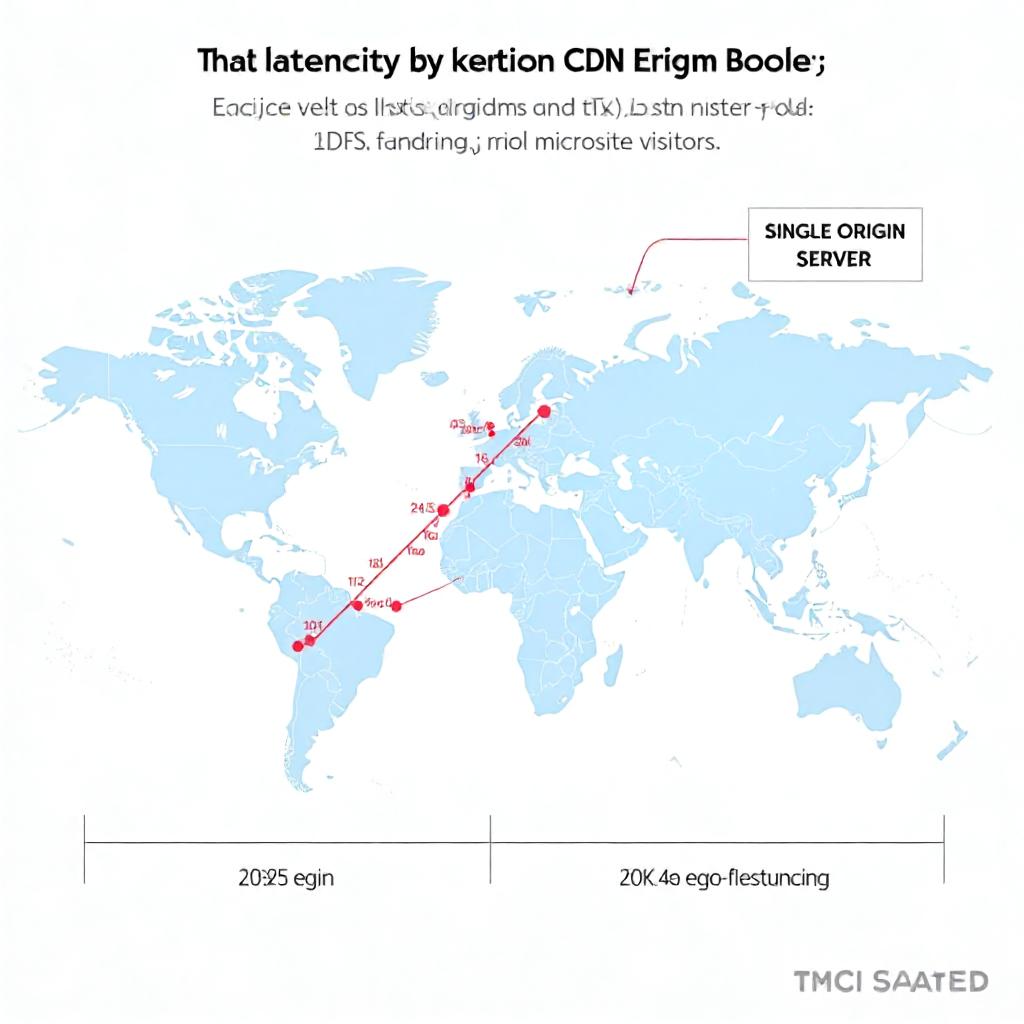
When a user in Singapore requests a microsite whose origin server sits in Frankfurt, without a CDN that request travels thousands of kilometers, waits for a response, and returns with the content. With a CDN, the same user is served by an edge node in Singapore or nearby — cutting round-trip distance dramatically.
For a hosted microsite, the CDN typically caches static assets — HTML, CSS, JavaScript, images, fonts — at each edge location after the first request. Subsequent visitors in that region receive those assets directly from the edge node, without touching the origin server at all.
This is different from a generic CDN explainer because microsites are almost entirely composed of static or near-static content. There's rarely a dynamic database query or personalized server-side render on every page load. That makes microsites an ideal fit for aggressive edge caching — the CDN can serve the vast majority of requests entirely from cache, at very low latency.
Reducing Latency for Globally Distributed Audiences
Geographic distance between a visitor and the origin server is one of the most consistent causes of slow Time to First Byte (TTFB) — and TTFB is the metric that shapes a visitor's perception of page speed before anything even renders.
Every additional 100 milliseconds of network round-trip time adds measurable friction. For geo-distributed traffic arriving from multiple regions simultaneously — which is common in campaigns running across international markets — a single-origin server creates an uneven experience. Visitors close to the origin load quickly; everyone else waits.
CDN edge nodes eliminate that asymmetry. By placing content at PoPs in North America, Europe, Asia-Pacific, and other regions, a hosted microsite platform can deliver consistent TTFB to visitors regardless of where the campaign is running. A visitor in São Paulo and a visitor in Tokyo both receive content from a nearby edge node, not from a server they're geographically distant from.
For agencies running paid campaigns across multiple countries, this consistency translates directly into more predictable conversion rates. Performance variance by region is one of the harder problems to diagnose in campaign analytics — and CDN coverage is often the solution that resolves it.
Static Asset Caching and Its Impact on Core Web Vitals
CDN caching of static assets has a direct and measurable effect on Core Web Vitals — the performance signals Google uses to evaluate page experience and influence search ranking and ad quality scores.
Largest Contentful Paint (LCP) measures how quickly the main content element renders. For most microsites, that's a hero image or headline. When CSS and images are cached at the edge, the browser receives them faster, and LCP improves. A microsite that might score poorly on LCP when served from a distant origin can often meet the "Good" threshold simply by enabling CDN delivery.
Interaction to Next Paint (INP) and Cumulative Layout Shift (CLS) are also influenced by how quickly JavaScript and fonts load. Fonts served from an edge node rather than a remote origin reduce the render-blocking delay that causes layout shifts. JavaScript bundles cached at the edge load faster, which reduces the window during which the page is unresponsive to interaction.
For agencies running Google Ads or Meta campaigns, page experience signals feed directly into quality scores and cost-per-click calculations. A microsite with strong Core Web Vitals can cost less to run and convert better — making CDN configuration a legitimate lever for campaign ROI, not just a technical nicety.
One practical consideration: cache-control headers need to be set correctly for this to work. Assets with long cache lifetimes benefit from aggressive edge caching, but HTML files that might change between campaign phases need shorter TTLs or a reliable cache invalidation strategy. Getting this wrong means visitors see stale content after a campaign update — a real problem for time-sensitive promotions.
CDNs and Reliability During Traffic Spikes
CDNs protect microsite origin infrastructure during sudden traffic surges by absorbing the majority of requests at the edge before they ever reach the origin server. This offloading is what keeps a microsite online when a campaign goes viral or a paid media burst drives thousands of concurrent visitors.
Without CDN offloading, a spike in geo-distributed traffic hits the origin directly. Even well-provisioned servers have limits, and microsites are often hosted on shared or mid-tier infrastructure — not the kind of setup designed to absorb a 50x traffic increase in 10 minutes.
The CDN acts as a buffer. Because most microsite assets are static and cacheable, a high cache-hit ratio means the origin only receives a fraction of total requests — typically the initial cache-population requests and any dynamic calls. The rest are served entirely from edge nodes.
For digital agencies managing multiple client microsites under one hosted platform, this reliability matters at scale. A traffic spike on one client's campaign shouldn't degrade performance for others sharing the same infrastructure. CDN offloading isolates that load at the edge, protecting the shared origin from cascading failures.
Security and SSL Termination at the Edge
CDNs handle HTTPS handshakes, DDoS mitigation, and bot filtering at the edge — reducing both security risk and the processing load on origin servers. For agencies managing multiple client microsites, this edge-level security layer is a significant operational advantage.
SSL/TLS termination at the edge means the computationally expensive process of establishing a secure connection happens at the nearest PoP, not at the origin. Visitors get a fast, secure connection; the origin server receives an already-terminated request over an internal secure channel. This reduces TTFB further and removes SSL processing overhead from shared origin infrastructure.
DDoS protection at the edge is particularly relevant for microsites attached to high-profile campaigns. A product launch or political campaign microsite can attract unwanted attention. CDN-level traffic filtering absorbs volumetric attacks before they reach the origin, keeping the microsite available for legitimate visitors.
Bot filtering matters too. Campaign landing pages attract scraper traffic and fraudulent ad clicks. Edge-level bot management can filter these requests without adding latency for real users — something that's difficult to implement effectively at the origin server level without affecting performance.
Choosing the Right CDN Configuration for a Hosted Microsite Platform
The right CDN configuration for a hosted microsite platform depends on four practical considerations: cache invalidation strategy, custom domain support, edge rules flexibility, and how well the CDN integrates with the microsite builder or hosting layer.
Cache invalidation is the most commonly underestimated factor. Microsites change — campaign copy updates, A/B test variants swap in, countdown timers need fresh data. A CDN without reliable, fast cache purging will serve stale content to visitors after updates, which can undermine the entire campaign. Look for platforms that expose programmatic cache invalidation through their API.
Custom domain support matters for branded campaign URLs. A microsite at a custom subdomain needs the CDN to handle that domain correctly, including SSL certificate provisioning. Some hosted platforms handle this automatically; others require manual DNS configuration. For agencies deploying microsites at volume, automation here saves significant time.
Edge rules — the ability to set custom headers, redirect logic, or geo-based routing at the CDN level — add flexibility for campaigns that need regional variants or compliance-driven content restrictions. Not every microsite needs this, but having the capability available without requiring origin-level changes is useful.
Finally, integration depth matters. A CDN bolted onto a hosting platform as an afterthought often creates friction: cache invalidation is manual, SSL provisioning is slow, and edge rules require support tickets. A hosted microsite platform with CDN infrastructure built into its core — rather than layered on top — delivers a meaningfully better experience for both the agency and the end visitor.
Frequently Asked Questions
Does a microsite need a CDN if it only runs for a few weeks?
Yes — the short lifecycle makes CDN delivery more important, not less. There's no time to fix performance issues after launch, and campaign traffic often arrives in geographic bursts that a single-origin server handles poorly. The cost of poor performance is concentrated in a very short window.
How does a CDN affect SEO performance for a microsite?
CDN delivery improves Core Web Vitals scores, which are a confirmed Google ranking signal. Faster TTFB and better LCP scores can improve organic visibility for microsites targeting search traffic. For campaign pages relying on paid search, better page experience scores reduce cost-per-click in quality score calculations.
What is the difference between CDN caching and browser caching for microsites?
Browser caching stores assets on the visitor's device for repeat visits. CDN caching stores assets at edge nodes for all visitors in a region, including first-time visitors. For a short-lived microsite where most visitors arrive only once, CDN caching delivers the performance benefit that browser caching can't — because there's no prior visit to cache from.
Can a CDN help if the microsite's origin server is in a single region?
This is exactly the scenario CDNs are designed for. A single-region origin creates high latency for visitors in other regions. CDN edge nodes cache and serve content globally, so the origin's location becomes largely irrelevant to visitor experience after the initial cache population.
How do digital agencies manage CDN configurations across multiple client microsites?
Agencies managing hosted microsites at scale typically rely on platform-level CDN management rather than configuring each microsite individually. Hosted microsite platforms that include CDN infrastructure allow agencies to apply consistent cache policies, SSL provisioning, and edge rules across all client campaigns from a single interface — reducing operational overhead significantly.